
 With another camp behind us and Steven struck down with the usual post-camp cold, it seems like an appropriate time to write a little about the importance of RECOVERY in the training cycle. Whilst one cannot refute that hard work = results, that comes with certain caveats – the most significant being the requirement for adequate RECOVERY. The process of resting the body after after a workout, replenishing energy , enabling the repair and rebuilding processes within the body enables you to get up and go at it again with full vigour the next day. This can be applied on a longer scale too – after a heavy training week, or block, the body, nervous system and mind need time to regenerate, “absorb” the training and return to a less stressed state. With a good balance of training stress and recovery, the body adapts to the training demands placed on it and you grow fitter and stronger. Simples! However, far more time is spent by the average athlete planning and focusing on the training side of the equation. When we look at the habits of professional athletes, triathletes in particular, we see that –sure they do train a lot, train hard, train smart …but far the more noticeable distinction is their attention to recovery. Almost obsessive. To get world class results one needs to be on top of the game for each and every workout…and that means paying attention to a plethora of details during the 18 hours of the day that are not spent working out.
Whilst some of the practices of full time athletes are just not practical for those with full time jobs, families and possibly even other interests…there are some simple steps that we can all take to ensure that we are getting the best value out of our training sessions, and maintaining good health and energy through the rest of our lives.
I will list some of my top tips, and also cover a few other ideas that are believed to help aid, or speed, recovery.
The first stage of recovery is your Cool down/Stretch – Whilst we may not often include a “cool down” into our training sessions (other than perhaps after a particularly hard set of intervals) it’s worth baring in mind that some light activity which keeps the body moving post-workout, or gentle stretching, helps to alleviate the muscle stiffness that can set in after an intense session. If you plan on driving home from a race, this one is particularly worth noting – take yourself for a walk or so in on the bike before loading up the car! Personally I find that a short light jog after a hard bike session, or in the evening after a morning run workout makes me feel much better for the following morning’s training – I have also found that a few hours working in the garden achieves the same!
The next – and possible most important step – is to Rehydrate and Refuel. You need to replace fluids and electrolytes lost if you have sweated heavily, the energy used during the workout and also provide your body with the nutrients required to rebuild and repair muscle damage. For this we seek a mix of protein for muscle repair and rebuilding and carbs to replenish glycogen stores (the carbohydrate-based “energy” stored in your muscles). The sooner after the workout the better – this is where a proprietary sports nutrition product such as the Powerbar Recovery that we were using on camp comes in handy. The ready-mixed protein drinks or single serve powder sachets are perfect way to start this process in the car on your journey home, or at your desk if it’s right on to the day job after the workout. For real food fans, a small meal such as an omelet or yogurt with banana and peanut butter are my personal favourites – and usually a big strong coffee too!
Sleeping – after refuelling, this is the best thing that you can do for your body to aid recovery . During sleep our bodies undertake repairs – both physical and mental. Hormones are released into the blood to heal muscular and cell damage whilst the brain is busy consolidating neural pathways during sleep. Whilst sleeping we are in a state of complete rest, with minimal stress on our energy systems and all hands turn to repairing, rebuilding and recharging. Furthermore, any information or motor-skills learned prior to a nap have a far better chance of becoming engrained in our subconscious if we sleep after the practice, according to studies by neuroscientists. For most of us with day jobs, post-workout naps are difficult, so ensuring enough sleep each night is our best route to faster recovery. With early alarm calls, this usually means getting to bed earlier – however on days following a race or big session, plan sleeping in rather than that early morning training session.
Massage – is not something that should be associated only with injury or niggles – regular sports massage will ensure the health of your hard worked muscles and help to prevent those niggles ever occurring. A good sports massage will break down tight spots or trigger points in muscles as well as flushing toxins out of the system and encouraging fresh oxygenated blood in. Additional benefits of improving alignment and treatment of reflexology points look after the body as a whole structure, and help the entire system to recharge. An hour on the massage table is a fantastic way to distress and relax, and just listen to your body (as well as the advice given by your massage therapist!). Self massage and the use of foam rollers, tennis balls and other aids is something that we can do for ourselves on a daily basis – the more that muscles are treated to massage, the better they respond to it.
Compression/Ice/Elevation – are all elements that I have used from time to time – usually only when training load and general muscle aches are at a peak. I view them as short-term relief from the discomfort associated with the natural parts of the recovery process and/or methods of speeding it up artificially. They all work on the principles of speeding blood flow around the body, thus washing out toxins and driving more oxygenated blood to damaged muscle, and reducing inflammation. Cold baths are a favourite method of mine, especially when training in hot climates, as I find that as well as reducing the ache in my legs, being cooler helps me to sleep better too.
Supplements – can help athletes by protecting their general health, especially their immune system which can be hit hard by the constant load inflicted by hard physical activity and erratic eating habits of athletes. Use of vitamic C, the most common anti-oxidant is recommended for this, and there are a plethora of other anti-oxidising supplements available too. A diet that contains a high proportion of processes sugary energy foods is part and parcel of those long training sessions and hastily consumed recovery meals….but are not optimum for our general health and so foods or supplement which can counter the acidifying nature of these will help to maintain a healthier balance. The use of supplements containing nitrates and phosphates are also considered to help neutralize – or “buffer “– the build up of hydrogen ions in our muscles during high intensity work, and there are several products on the market which supplement these elements and reduce muscle soreness during and after training.
Low Stress – emotional or mental stress is just as harmful to your body as the stresses exerted by physical exercise, so the more that you can reduce this in your life, the better the quality recovery you can achieve. Whilst what life throws at you in unavoidable and we all gotta work to fund our passion for triathlon – there are simple measures that you can take to limit the stress in your life. You’ll find that you sleep, eat and relax better when you don’t sweat the small stuff…and that can be achieved mainly through good organization. Simple things like planning ahead, creating routines and applying curfews don’t need to detract from your commitment to your job, family or other commitments …they may just make you a little more effective and save you time, energy and reasons to worry.
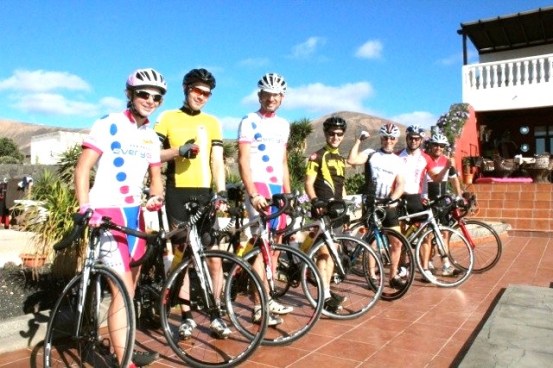 Well, after a very relaxed morning, with a few sore heads, we saw the majority of the week’s athletes off for their flights home, with the usual sadness. Steven and I always really enjoy running our camps and this has been no exception. We had a relatively small group, mostly English Blokes of a Certain Age, who bonded very well, providing a fun atmosphere and good humour with plenty of “in-jokes” and banter through the week. We received very good feedback about the new venue and format for this camp – care of TriSports Lanzarote, providing a touch of luxury and extra home comforts to the environment, as well as a more relaxed schedule which gave more time available to enjoy it! Something half way between a training camp and a holiday, this camp was designed for athletes with autumn/winter races wishing to tune up their summer fitness in a warm climate, with less emphasis on building endurance than the full-on train-fest that we are better known for (a la the Endurance camps in March). We wanted to offer more focus on coached training sessions, thus making the camp equally suitable for athletes seeking an opportunity to develop particular aspects of their training in a focused environment, and less experienced athletes. As it happened we had 4 experienced Ironman Athletes and two relatively novice athletes along – both of whom did exceptionally well in this environment, were good listeners, quick to learn and keen to “keep up” with the hard working ethos that the others inspired. Steven and I are not ones for “hand-holding” and tend to view lack of experience as just that. So we aim to provide as much opportunity to gain experiences as possible, rather than bail-out options on our camps! Alex and Alexei both thrived in this environment and as well as picking up a lot of technical tips and advice, they also learned to Man Up and give it a go rather than be restricted by the labelling of “Novice” or “Beginner”.
  We couldn’t run a camp without including an aquathlon – and being based so close to Peurto del Carmen, we were able to use the same course that we have raced in all of our spring Endurance camps. But this time we added a twist and “calculated” handicaps for everyone based on a timed swim (from Sunday’s CP test in the pool) and a timed run interval (from yesterday’s hill repeats workout). The race was clearly designed by a swimmer; with a 1.3km swim followed with a 4.6km run, most athletes spend longer in the water than running, and his was even more skewed this year by a high tide and strong currents. Also, an ability to sight and swim a straight course plays a massive part in the outcome of this race…and as ever, those of us watching the race were table to see the athletes swimming in all different directions. This got to be quite a concern in Nigel’s case, who took off on a bearing to the far left, managed to miss the end of the continuous line of buoys that we use as the far turn-around- and continued swimming way out into the open ocean. Eventually common sense kicked in and he started to make his way back to shore….by which time most athletes were already well into their second lap. I made a judges decision and allowed him to swim a much reduced (and easier to sight) second lap in attempt to even out the racing, which looking at the swim splits did seem to balance his swim reasonably well. Once on the run leg ,there was in theory a good chance to the weaker swimmers making up a lot of time, and we saw great running by Daz ( for Marc, who cant run due to achilles problem) and Nigel, but neither could catch Alexei, who held them off with a decent run of his own and crossed the line in first place. It was worth noting that although Steven employed smart sighting – by looking back to land features rather than trying to spot the elusive line of buoys ahead – and swam a very straight course, his swim time was still significantly slower than in previous years, confirming that sea conditions were tough today.


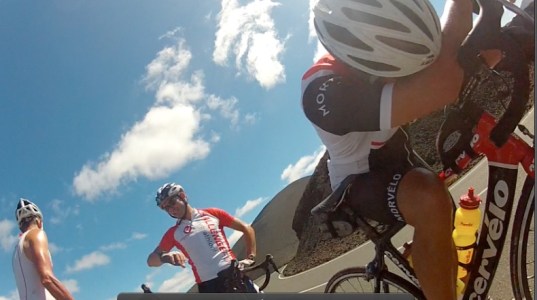
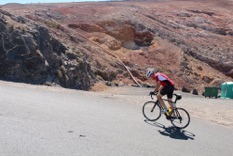 Once again, we managed to judge the difference in departure time for the two groups exactly right, so that Steven and Andy G were starting the Femes climb just as my group had all finished it..with Daz and Alexei soon after them. Debs had driven out to join us for the planned coffee stop at the top and took some fantastic action shots. After a long break which included coffee, ice cream, cans, more coffee and more cans, it was just 45km left of the course, over Fire Mountain and returning as per the full Ironman course down the “Donkey Track” to PdC. The headwind for this part made it a bit of a slog, but it might be more accurate to attribute that to a pretty solid week’s training, and certainly more than some of these guys who have not had a EverydayTraining Camp experience before are accustomed to.
  Day 5 of the camp…and suddenly we are all thinking about the fact that tomorrow will be our last day and wondering where the week has gone! The schedule for today saw us back in the pool for a CP set…it was hard work this morning, but we do enjoy swimming in this pool. It always delivers some amusing incidents due to tired athletes, wide arm recoveries, turbulent waters and a few entanglements with either the lane ropes or one another!


 This morning’s open water swim was an endurance session, and we all swam a lap of the Ironman course, with the faster group adding in a lap of the Aquathlon route which we will race at the end of the camp.

 Today was our first open water swim on the camp, dark as we piled into the TriSports van at 7am, and still a little low on light by the time we arrived on the beach ,However, it’s remarkable how fast it does get bright once the sun is above the horizon, and we were able to start our session on time at 7:30. We set out a 500m lap of buoys ( two of the permanent buoys and two of our own placed just off shore) which we swam around as a warm up before doing some sighting exercises, swimming the diagonals across our square of buoys. There was a pretty strong current ( I swear!) which compounded by the bright sunlight and relatively small size of the buoys we were sighting for, made it much harder than anticipated . I admit that I performed very poorly at this apparently simple task!
  It was a slightly earlier start this morning, and it was only barely light as we hit the pool for our coached swim session. The hour-long set included some warm up and drills then a 1600m main set which was designed around our calculated Critical Paces from yesterday, on long repeats.
 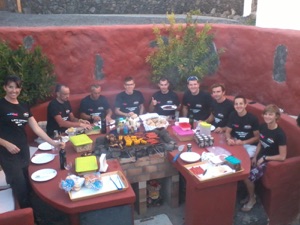 Whilst the BBQ hotted up for our dinner, we waited for the return of out long –distance cyclists, who were much later home than expected. They’d had a tough day with the heat and the amount on climbing within that 100 mile ride…and Andy G apparently blew spectacularly with the climb out of La Santa to go. It was a 2-Magnum day, a record he reckons, but still working at about 2000kcal deficit! A lack of calories of that scale really can’t be rectified with ice-cream and jelly snakes, as he discovered ,so it was tough going to get home.
  Day 1 Started with a swim, coached by Steven. The pool looked spectacular in the early morning sun, and 6 of us shared the two lanes with slightly differing sets according to swimming pace general endurance in the water. Both lanes undertook a Critical Pace test – the standard 400, 200, 100 meters time trials that this involves modified for the less experienced swimmers to include only the 200 and 100 TTs. It was amusing to swim in this long narrow pool – which is a full 25m in length but only a little over 2 standard lane-widths across, with high walls on each side. The effect of this is visually stunning, but creates a rather choppy environment with 6 swimmers going flat out! The consensus was that this probably effected swim paces by 3-6 seconds per 100m. However, due to the nature of the Critical pace calculation, which looks at pace drop off over the varying distances, rather than the actual TT paces, the test is still valid – and certainly will be very relevant for basing our week’s swim sessions around.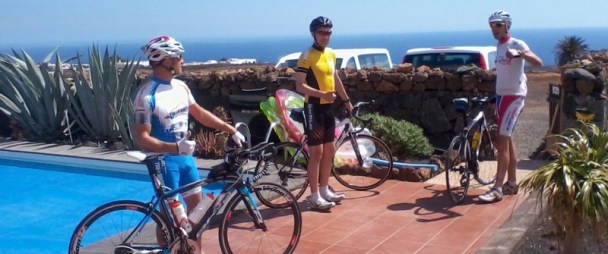
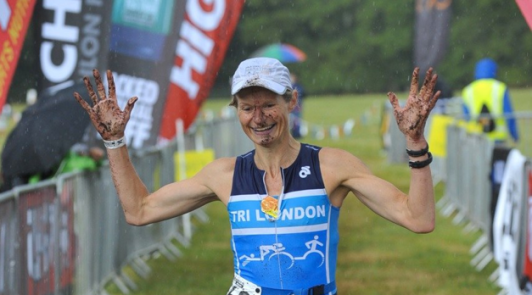 For the first time, the world-wide Xterra off road triathlon series comes to the UK, with the event held in Vachery, Surrey on 8th September. Olivia Hetreed, has been racing triathlon since her early forties and was the very first athlete to be coached by EverydayTraining when she approached Steven and Jo, as fellow TriLondon club mates, for advice. Olivia’s balanced outlook, consistent commitment to training and clear love for racing has seen her performances improved season on season, with a trophy cabinet now brimming with prizes. She has represented GB in numerous World and European Championships at Olympic distance, and has recently taken to Middle Distance racing with equally impressive results. During the “off” season Olivia likes to play off road…and stays in shape and fresh with mountain bike, trail running and duathlon races with funny names. This year, having elected to decline the invitation to pay a £200 entry fee to represent GB in the Worlds in Hyde park, Olivia spotted the Xterra race on her doorstep (Olivia’s policy on her minor events selection is generally based around whether she can cycle or catch a train from her London) and signed up. She then went away on holiday. Here’s how it panned out, in her own words:
 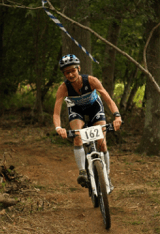 All kit in transition is soaking – pools of water on my towel. Luckily I put my dry clothes in a plastic bag so I can get changed and a nice man gives me a silver foil jacket to wear – crunchy and ridiculous but definitely helps me not to freeze before the sun comes out again for the Prize Giving.
  EverydayTraining