
Lanza Camp 2012 Day 3

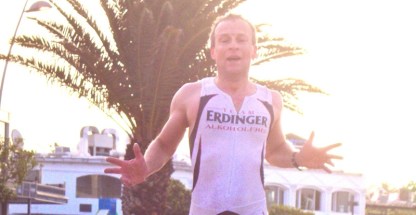
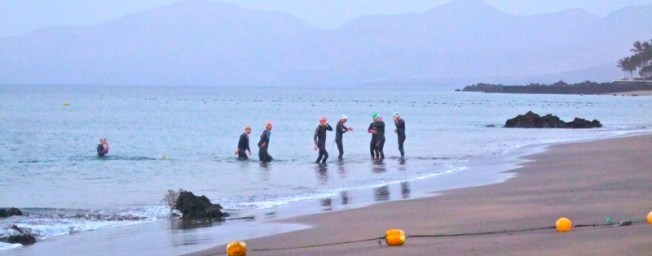
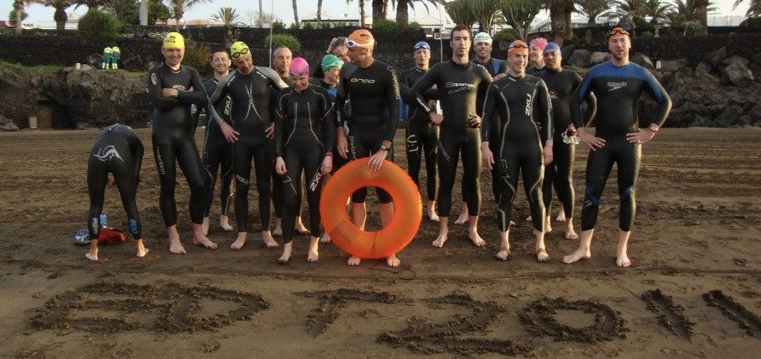
DSC02303Day 3 begins with the gang assembled in wetsuits at 7:15am. It’s still dark and there are reports of restless night’s sleep and pre-ace anticipation as we make our way to transition….several comments are made about how akin this feels to Ironman morning! We’ll just be racing 1500m + 5(ish)km for our aquathon but with two solid training days in our legs, we’re all feeling at least apprehensive. Not least because in the pre-dawn gloom no one is able to see the big orange rubber ring turn buoy that Steven has tied about 350m from the shore. Luckily, once it’s started to get light it brightened up very rapidly and we’ everyone was reassured and good to go: two out-and-back laps for the swim. Various degrees of straight line were taken to reach the buoy, and Mel’s swim pace was almost as  impressive as her utter inability to navigate a direct line between two fixed points. It’d be odd not to make some mention of jellyfish at some point in this blog: some were seen and felt as were several unusual looking rays. Transition included a run up the beach, then a brutal set of steps to our change area, before we ran out on our 2-lap run course along the seafront, which most people noted was not very flat!

It was great fun for me to have swum the second lap with Kevin and Simon and leave transition with them both close behind me. Kevin soon showed me his heels, whilst Simon was contented to look at mine. I was determined to catch Mel, and did manage to make up a little ground, but her 3min15second lead was too substantial in the end. The race was taken by Tim closely followed by Roger – two very impressive performances from two very competitive characters! It was great to see that everyone was giving it a good effort – and from the banter afterwards it seemed enjoyed the race. Marc A swam a 24 min 1500 and then withdrew on grounds of an achilles problem – he will complete the camp having earned a discretionary Wildcard by swimming back out to untie our marker buoy for us! 
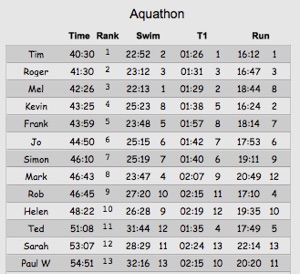
AquathonHere are the results of our aquathlon race which will be used to handicap the rest of the events on the camp – from here on we’re racing for points, and points means prizes!!!

All the racing talk and provisional results made for some jolly breakfast banter before kitting up for our days riding. Today’s route was a ride of the Ocean Lava half-ironman distance course, with a few tag-ons to make up a 110km ride for a “Wildcard”. This gruelling race includes an ascent of Femes’ steep side before going over Fire Mountain. Those who had earned a Wildcard yesterday were able to avoid this, the hardest climb on the island. As per yesterday, we organised two departures – one group rolling 15minutes ahead of a slightly faster group. There were a few pairs of tired legs as we pedalled up the unavoidable climbs out of Puerto d Carmen, and it took a bit of rallying to keep our large group moving! An earlier departure does allow this easier pace, and Emma and I managed the gaps between us. With the stronger riders making roundabout loops or rolling back along the raod rather than roadside regroup stops, and after half an hour or so had a nice continuos flow with everyone riding a pace that was comfortable for them (under the circumstances!) whilst maintaining the feeling of being on a group ride. Steven’s faster group probably has a lesser spread of pace and employs different tactics for keeping the group together  –  although every time I saw him today , he was on his own at the top of a climb!! At the break point between the standard and long ride option (which was to approach Fermes via Playa Blanca) we said goodbye to Emma, Simon and Ted and also Paul W who was playing his “wildcard” and saving his legs. We gained Kevin from the fast group, which proved useful on the return across the lava fields! 

It’s been a tough three days and having ridden with her for 3 days now, I’ve been very impressed with Sarah, who took up ironman only recently having been inspired to do so whilst providing massage for our camp here last year. These are big rides and at a challenging pace for her – especially on top of everything else on the camp. But she’s kept on pedalling (with a little less than gentle encouragement at times) with must less rest than most of us, tucking in and hanging on a wheel for the last hour or so to get the job done and home when necessary – all without so much as a pause in her cheerful patter. We’ve thrown some hard work at her and still not found her “grunt point”!

An early return to base enabled me to get some mechanical works done on my bike and have a massage whilst others sunbathed – or went out to bank a second run. I have to confess that I’d planned to do just that whilst my bike was worked on, but “legs said no!” so I’m most impressed by the oldies who did ;o) 
READ EMMA’S BLOG HERE


Posted in Camps, Lanza 2012 | Tagged , | Leave a comment

Lanza Camp 2012 Day 2

DSCF1843Another Jelly Fish free day ! Checking for them each day is almost certainly going to mean I get most swim KM this camp as I get between 300 and 500m done before everyone else arrives on the beach. The more I swim and don’t see them the more confident I am about none being out there. It being dark doesn’t really help though.
This morning we did starts and exits in the swim. Like last year it was great fun. Sprinting in to the sea and swimming a max effort 100m round a buoy certainly wakes you up and I expect it’s the most intense work anyone will do all camp.

Today’s ride was a pretty challenging route and so we had a group willing to make a quick breakfast to get an early roll out. The ride was heading north up to Orzola, into a headwind, before taking on the challenging ascent of Mirador Del Rio, and then reversing the Ironman Route as far as Teguise. To earn a Wildcard we said that campers would descend back down to the LZ-1 from Haria and re-ascend via Tabeyesco. This Wildcard will allow them to cut the climb of  Femes out of tomorrow’s ride.

I was with the second start-group and I was really chuffed with how we worked together. We had started out friendly with a compact group and everyone chatting away until Roger punctured at which point we split with part of the group continuing steady to Orzola whilst three of us waited with Roger before we chain ganged for 20 KM to Orzola, some hard work but great fun.

Jo also reported her group had been riding together really well. We bumped in to them at Orzola and then again at the top of Mirador Del Rio which was super satisfying as our planned timing was working out bang on. We even arrived at the Haria decision point together where a large number of campers chose to descend and ascend Tabeyesco in pretty tough conditions – strong head winds and ending in the mist.

The final section home we motored with Tim putting us to the sword chasing an average power. Certainly was the final nail in the coffin for me until I saw the group that had done the standard ride ahead and decide to work a little to try and get us to finish the ride together. We caught them within 500m of the finish and it absolutely made my day for it all to come together like that.

Those that had earned a run wild card yesterday were pretty pleased to be able to play it and avoid running off the bike whilst the others showed the true camp spirit and headed out for their 30 minute run minimum.

Steven

ElGolfoTT1Corrections and apologies:

I made a mistake with my math resulting in an incorrect time trial result for Helen who actually rode 33:14 rather then 35:14 as previously stated. Sorry Helen!!

Jo

READ EMMA’S BLOG HERE

Posted in Camps, Lanza 2012 | Tagged , | Leave a comment

Lanza Camp 2012 Day 1

24032012146After a day of mostly smooth airport pick-ups, hotel check-ins and bike assembly and shake-down rides, our camp of 13 athletes, and 5 staff assembled for the formal welcome and camp introduction on Saturday evening. Having run through details of the week that will follow, including the camp points competition, handcapped races and the concept of “camp completion” …we sent them to bed with two warnings. One, that they would be loosing an hour’s sleep due to the clocks changing form winter to summertime and Two, that we may not be able to swim in the sea due to the sudden appearance of large swarms of jellyfish. There have been jellies in the bay across Peurto del Carmen since Janurary, due to some underwater volcanic activity, and although they’ been keeping themselves very scarce all week, on saturday morning they had returned with large-scale reinforcements. What a bummer! We had been unwilling to enter the water and we could hardly expect the group to do so.
Fortunately, we sent Steven in ahead to scope out the situation, and he reported “All Clear”. They disappeared just as suddenly as they came, presumably just on a day trip to the resort ,and are of in the ocean or bothering beach goers someplace else. So, we were able to get our fist session of the day done and those who wished to had the opportunity to bank a little extra swimming in case of infestations later on it the week. Due to the suddenness of their appearance, we must assume that it could happen any day through the week, and will have to assess the situation each morning . Of course we’re keeping our fingers tightly crossed that if it will happen,it wot be on the days that we have scheduled our swim-based races.

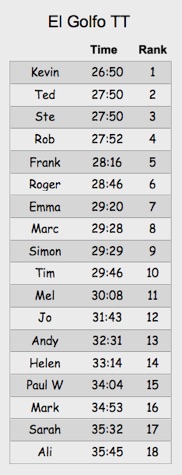
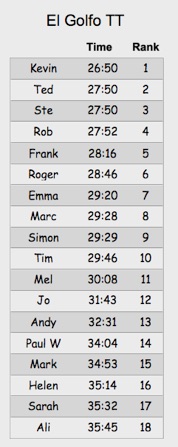
The second session of the day was a ride oriented around the 10 mile El Golfo Loop time trial. This is an exact repeat of last years’ day 1 bike race, which will be used to handicap the cycle “points” race so we were able to make some comparisons of times for the 9 campers/staff who have returned. Despite very windy conditions today which analysis of these time comparisons we reckoned to account for 40-50 seconds we did have some great performances and a few PB’s – notably Ali, Ted and Emma (all of 1 second!!). The fastest ride of the day was Kevin, who had finished in 3rd place in 2011, though he was unable to better that time due to the conditions.  The big battle between Tim and Roger, our top 40-45 age groupers was easily resolved by Tim, who ha raced Ironman Lanarzote  three times before AND ridden a preview lap of the route this morning, taking a wrong turn on the loop and detouring into a carpark. He must have really been pushing it!!

Here are the resultsElGolfoTT

Over a relaxed coffee we split into groups for the remaining ride, a 35km route over Firemountain. With strong head winds this was quite hard on the legs, but the pace of the riding was comparatively fast  in all the groups as everyone is fresh and keen, so the descent down the Donkey Track with a tail-wind was a well earned pleasure at the end of the ride. It was a relatively short day on the bike and so Steven and I were impressed with the spirit of those who used the spare time to ride a little further or do long runs.

For myself it was a blessing to run the half-hour minimum and  have a little spare time in the afternoon, enabling me to join a few of the other sensible campers for Ali’s poolside stretching session and get ahead of some camp admin so that I might catch up that lost 60 minutes of sleeping.

I’m going to need it!

Jo

READ EMMA’S BLOG HERE

Posted in Camps, Lanza 2012 | Tagged , | Leave a comment

Training Camp Survival Guide

P1010337.jpgUntil 2008 a “training camp” for Steven and I was nothing more than booking a week’s holiday and heading somewhere inexpensive and warm with our bikes – a precious 6 days dedicated to getting as much swim, biking and running that we could fit into that time, with very little else besides. We’d heard about organised camps – but both self coached at the time and sufficiently motivated it wasn’t until we heard about Epic Camp that the idea had any appeal. E[pic camps were something a bit different form the “norm” – an 8-day camp for athletes of a certain calibre with an emphasis firmly on volume but with a completive element which encouraged some racing and hard rides. Throw enough egos and training junkies  into that environment and you get something very special and we were fortunate enough to be invited back after Epic Italy 2008 for two further camps before the Grande Final tour of NZ which marked the end of Epic.  Since  reinventing myself a a professional athlete, I have been on a few extended camps with a group of friends, also professional triathletes, appreciating that in order to get through some of the hardest work, it’s necessary to create a highly focused environment – easy access to training good facilities, weather and company within a simple routine with few external distractions.

As coaches we wanted to try and recreate some of the essence of all of these types of training camps – an environment where serious athletes challenge one another and themselves, and bank a bigger week of training than would be achievable under their own steam, let alone in their home environment.  We do aim to make our camps more accessible the Epic – both in terms of athletic ability and budget, but expect everyone to be challenged during the week. With the second such camp about to start, it feels like an appropriate time to post up a few of our tips and tricks for Training Camp Survival.

As illustrated to some extend already – there are a variety of different types of training camp and an even wider range of reasons for going of camp. For some it’s a very serious period of hard and focused training, meeting personal targets and pushing fitness limits. It can be a final pre-race polish block or the kick-start to a return to fitness at the start of a season. For some it’s a nice opportunity to partake in actives that they enjoy in a nice climate and the company of fellow enthusiasts. Others may be along specifically to engage with the coaches and glean some first hand training advice and race tips.

1- Number One on my list of survival tips is – to be very clear about what YOU want to get out of the camp, ahead of the camp. you may even want to write this down somewhere you can refer to during the camp.  This bit of advice actually comes from Gordo in the context of embarking on an Epic camp, and I feel that it holds true for any similar environment. As you go through the camp week, your perspective changes. You’ll meet new characters and make alliances who will both motivate and influence you, you’ll become caught up in ‘games’ and contests, and as you become tired, your mood and/or judgement will be affected. It pays to remind yourself of what your ‘game plan’ was at the start of the week, and what it is that you most hope to get out of the week.

Steven’s input when I asked him was to “Be Gutsy” meaning that often people don’t get all they can out of a camp because they leave it too late to do more or push harder. If you on camp to really challenge yourself and find the limits ,then do give it a go early and you may be surprised at what you can accomplish. But be “Gutsy”  enough to back off or create an easier day if you feel you’re digging a hole for yourself and it’s heading away from your initial stated aims of the camp.  Sitting alongside this tip is a reminder that it is important to remember that others may be there for different reasons to yourself  – respect where they are coming from and behave in a way that supports this as far as you can.

2- Nutrition – after the training (and possibly before) this is the area that will occupy most of your thoughts and is a critical factor in surviving and gaining fitness through a camp. When self-catering it pays to get a big shop done at the beginning of your camp and taking turns to prepare dinner will mean that you only need to think about this every few days, so establish the eating preferences of the group that you’re with and  be prepared to be flexible in order to find the common ground. When on such camps we usually discuss our planned menu ahead of time so that we all have something to look forward to through the day, or the opportunity to raise objections! Personally I find that this is the best way to ensure i’m eating well when I need to be in tight control of my nutrition.  However, when on a more structured type of camp oriented around high volume, being catered for is a God-send and one of the aspects that makes it worth paying more for an organised camp package or full board accommodation. It’s easy to ensure that you are eating enough to fuel your daily activities and recovery this way. On the other hand, access to unlimited grub at the end of a hard day means you could easily leave the camp a little heavier than when you arrived!  If this is a concern for you then you may find it helpful to give your self a few ground rules regards mealtimes.

Key points may include:

  • Eat a decent breakfast. On camps we have seen some people struggle because they can’t eat enough at breakfast to fuel the day. If you’re like this, then try to get to breakfast as early as you can to give most time to get the food digested before the ride.
  • Ensure that you are fuelling well throughout your training day, so that you are not totally depleted and absolutley famished by the end of it
  • Have a recovery snack or drink as soon as possible after your last session (or between workouts if there is likely to be break of any length of time)
  • Start your evening meal with the best quality, most nutritious food that you can identify on the menu/buffet. Hit the least processed sources of proteins, good fats, and vegetables available. If you think of your breakfast and daytime eating as your training fuel, then the evening meal should be oriented towards essential nutrients for recovery, and need not be heavy on carbohydrates.
  • Eat slowly enough to get a sense of how hungry you are after this first helping. An awareness of the amount of food that you need at mealtimes is helpful: it’s tempting to eat more, especially treat foods,  when it is available and you feel deserving.
  • Avoid the highly processed or very sugary foods that are common on most buffets – take fresh fruit or yogurt for dessert.
  • Alcohol may help you to unwind at the end of the day, but is not nutritionally beneficial and may inhibit recovery. That’s your call.
  • Eat lots of eggs – they contain adrenaline (that’s what I’m told!)
  • Take your vitamins: keep your immune system topped up by taking your vitamin supplements. I’ll be hitting the Vit C, others use Colustrum or Echniachea.

3- Sleep. Closely following nutrition in the ranks of importance on the camp survival guide is sleep. When you train with professional athletes, this is something you pick up right away: during hard training block, if you’re not training or eating – then you’re most likely to be sleeping! As you know  -this is the time when your body repairs and your mind de-fuggs.  Unfortunately, the excitement, adrenaline, aching limbs and shared sleeping quarters  make it harder than usual to sleep during camp – let alone the chance that you’ll be rooming with a snorer! Ear plus are camp essentials.  It’s a good idea to establish a relaxing evening routine to help you unwind at the end of the day. My rules for camps are: computer off by 8:30, spend an hour or so relaxing, chatting, stretching or watching tv and to read for at least 10minutes in bed. I’ll also have a drink of chamomile tea with warm milk ( the tryptophan in dairy are good for sleep)  and if you know yourself to be a light sleeper then you may consider taking further steps to enhance your sleeping such as melatonin. Personally I carry a supply of over-the-counter sleeping tablets which will be deployed if i have had trouble sleeping for more then 3 consecutive nights whilst on camp.

4- Keep on top of bike maintenance and equipment. At the end of another hard day’s riding, and with a run to get out of the way, it’s very easy to throw the bike and your kit down and forget about it until the next morning. Only then will you remember that it was making a ‘funny noise’ all day yesterday and could be a mechanical waiting to happen. A little timely tightening or adjustment can save a lot of cost and wasted camp time, and things also tend to run easier if cleaned and oiled after a ride too. If you have unusual or very high-end components on your bike then it’s a good idea to bring spares and any associated tools with you, because local bike shops may not have what you need in stock. You’d be surprised how hard it was to find a Campanolo free body hub at short notice even in Italy!

5 – Keep on top of muscle maintenance! If you’re a Pro athlete on camp and you’re not training, eating, sleeping  (or twittering) then you’ll be either on the massage table, stretching, rolling or icing. Granted, it takes a little time and discipline, but  even just few minutes on your ‘hot spots’ at the end of each day can help to mitigate soreness through the night, improving your chance of good sleep, and reduce stiffness the following day. 

6- Maintain good hygiene. During a hard training week you immune system will be compromised and the chances are very high that someone in your group will get sick during the camp. Actually, it’s very likely that someone will turn up to camp sick .You’ll be doing your best to keep your immune system strong (see points 2 and 3) but special attention to hygiene is also essential when living in such close quarters, especially in a self-catered environment. It may be alright to drink from the carton, or leave used tissues around at home: on camp it is absolutely NOT!! Ensure that washing up is done thoroughly, food preparation surfaces are wiped clean and dish-towels are replaced regularly. It may be a good idea to place hand sanitizer in the kitchen and bathroom to endorse the habit to your room-mates. Keep your bottles clean with sterilising tablets, washing in boiling water or running through a dishwasher.

7 – Finally Make the most of the environment -the greatest resource available to you on camp is the other athletes. Having others around can really help you get out and do more. Arrange to run off the bike with people so you’re less likely to decide not too. If you’re in need of an easier day or an easier spell on the bike don’t be afraid to sit in and skip turns at the front on the bike. Let people know that’s what you need to get through the day, and most will do there best to help you through. Usually the shared experience will bond a group on camp pretty well anyway, but do take the time to get to know, engage with and learn from the people that you meet during the week. If you are on camp with a friends or a group from your club, you might be mindful that this can affect the dynamic of a group significantly – there may be people who have travelled alone and you can make their experience more enjoyable if you include them socially – but also exclude you from meeting interesting new people. Many long term friendships and training partners are the legacy of the camps that I have attended.

Posted in Advice, Camps, Lanza 2012 | Tagged | Leave a comment

Getting Ready For Camp

With a under a month until the start of EverydayTraining’s second warm weather training camp in Lanzarote, activity in the household is has taken on a distinctly office-based vibe of late. What better than a return to cold weather and the inevitable bout of post race/training block man/woman flu to draw our attention to the details of our next sunny project?

Returning to the same great apart-hotel that hosted us last year (and has been the Canarian base for steven and I plus various combinations of training partners over the years) makes that side of the logistics easy for us.

We’re also very fortunate to have Emma and Ali, the awesome ladies who helped us so much on last year’s camp, are willing to return and again lend ride and logistical support. The gals make great team, with Emma on hand to provide both cycling technique tips, group riding advice and “ego check” service for anyone who needs it on the hills, whilst Ali (Mills Physio) will be adding further value to the general physio and injury advice that was so well valued last year, by leading some pilates-based stretching and conditioning workouts to help get us through the camp in one piece.

As last year, massage services are provided by The Tri Touch and we’re delighted that (since last year’s masseuse has decided to come and experience the EverydayTraining Camp experience as an athlete this year!) it’ll be Tri Touch representative Helen Smith  providing the daily rubs. Helen is a long-time triathlete,  and former club mate of Steven and I from back in the Tri London days and we are sure that she’ll be dishing out a little hurt on the bike as well as (an appropriate amount)on the massage bench!!

We now have a full portfolio of Camp Sponsors in place. We are very grateful for the ongoing support of The TriTouch and Powerbar Nutrition which really help us to make our camps something extra special, not to mention great value for money.

In addition we have some awesome prizes and special offers from:

Blueseventy

TenPoint Triathlon

Freespeed

Primal Lifestyle

InformedFitness

So, you may be wondering what Steven and I are bringing?

Well, it goes without saying that the actual camp schedule is TOP SECRET information but the guys and gals can be assured of a full-on 6 days of great training plus some races and events to add a  little friendly competition and motivation into the mix. Steven has been a busy bee constructing some tools for tracking athletes training data whilst on camp and scoping out a few nice new cycle routes on the island.

And me? well, I’ve been doing the fun stuff: producing T-shirts and redesigning our website ….and making plans to get myself back into shape ready for march 24th  :o)

Posted in Camps, Lanza 2012 | Tagged , | Leave a comment

Kona

 DSC01878.jpgWhilst Steven was out in Hawaii enjoying his 6th time competing at the Ironman World Championships, I was glued to the IornmanLIVE coverage, which was simply brilliant. What an exciting race this year, in both the women’s and mens race. Of course, I wished I was out there and in the race myself, but for a supporter we sure had quite a show this year. And, this year has been a great year for me as a supporter, since besides Steven we had two EverydayTraining athletes competing in this iconic event for their first time. These girls have shown dedication and commitment to their training all year, despite the various hurdles that life throws in the way: injury, family & relationship commitments bereavement, work stresses, threats of deportation and swimming across the channel. It is this willingness to stick at the had work, adapting when necessary and not lose sight of a goal that Kona qualifiers share.  Both found the race tough – the climatic conditions, massive adrenaline buzz and general standard of the competition make this an Ironman like no other – but had good races, finishing in the top 20 in their age groups. 
Here are some of their highlights, shared with their permission, as described to me very shortly after the race.

Kerri

AG 35-39
Qualified by winning AG in at Ironman Coeur D’Alene (10:53:59)
First time at Kona, placed 19th in AG in 10:46:50

“Gosh, yeah it was a day of ups and downs I guess. Got hammered and hit in the eye in the swim and thought my time of just over an hour was crap but discovered that I came 2nd in my age group (and my bike in my row was the first to be taken out). Also saw a mother dolphin swimming below me with her little baby dolphin by her side – how cool is that?!

Bike was quite simply brilliant – I did everything we discussed with heart rate and I think it paid dividends… best bike time for me ever in a race even though I felt I was being passed by a million people! I honestly don’t think it affected my run but the next paragraph may make you think that… 

And then…. the run.. first 2 miles I felt strong and heart rate 150bpm and then discovered I was running 8 1/2 to 9 min miles and no matter what I tried I just couldn’t lift the tempo. Then I got severe stomache cramps and had to stop to the toilet in the energy lab with gastric distress which is part and parcel for me I guess. So basically it felt like I was passed by more women then I have ever been in my life and not many ever walked (also very disappointing). But I tried to end on a good note by breaking 11 hours so at least I got that goal and I guess a top 20 finish (just) isn’t too bad. 

Great experience but I am not sure I would ever be good enough to get a top 10 here. The run is very very tough. Also wondering at the caliber of the ladies whether I will ever qualify again either! They are amazing!

Tried to lift Steven’s spirits as I ran past him on the Queen K… it surprised me as he looked really really good earlier in the race and was lovely and supportive to me as well. 

Ok, so I am now in pain as per usual and sunburned as well. Do I want to keep doing Ironman ? Of course I do! So .. have to somehow work out how to run a good split off the bike! And qualify for Kona again.. I would never say no. It has been incredible fun. “

Mel
AG 45-49
Qualified by winning AG in at Ironman Lanzarote (11:28:55)
First time at Kona, placed 15th in AG in 11:18:06

“Having spent so long with Steven and Roger pre race I was buoyed by their positive attitude and decided to turn any negatives into positives. E.g if the swim was physical I was determined to enjoy this as a new experience and fight like the rest of them! On the bike I prepared myself to be overtaken by so many bikers by thinking what a great swimmer I must be ! Then if I needed to walk on the run, then that’s what I would do and try to take the time to look around and savour the atmosphere.Hence I started the race with positive feelings.

Steven had told me to be on the beach early, so there I was at 6:10. Suddenly I realised I shouldn’t have been there as all the pros were assembling. What a great time I had. It was awesome to see chrissie, thou she looked nervous. Leander Cave stood next to me with the cameras rolling as she put her hat on. One of the pro men got me to zip him up, then complained that the zipper was not up. He was clearly nervous as the zipper was like a blue seventy wetsuit. I had to take him to a photographer for him to confirm I’d done it right. This experience was a clear highlight. Then it was our turn, I waited on the beach as long as possible but had to get in at 6:40. Do think that sculling in the water for 20 mins trying to hold position on the front line is not ideal prep for the day ahead.

Then we were off. It was brutal. Unfortunately I had my goggles kicked off after about 10 metres and found I just had to swim blind for about 400 metres as I couldn’t stop as I would have been swum over. This was horrible as I got bashed to pieces as I couldn’t do the usual water polo type swimming to find space. Swim got better once I’d cleared my goggles, but as we approached the turn buoy I was aware we were heading straight for it. I wanted to move out a bit but other swimmers converging so again it was a complete bun fight. Still not sure why men seem to thing it acceptable to pull down on your shoulders or pull your legs back! If I make contact it’s by accident. Felt my toes cramp on the turn buoy and had to deal with it by stopping kicking for several minutes. Really not ideal when swimming so congested round the buoys. Thankfully it eased off. I felt I’d had a pretty tough swim so far, so tried to conserve some energy and swim on feet as much as possible.

Out on bike course, remembered to try to take it easy to begin with. Enjoyed the bike, kept positive thoughts when being passed, though mental note to try to improve biking. Did get a bit frustrated at bikers who passed then pulled in and slowed down so I had to keep backing off. Last 6 miles up to Havi turn was very tough, only travelling 8 mph. Took some pro plus and began to feel better. I felt good on the return but realised I was cooking, especially from mile 80 onwards. Had been taking water at every station to pour over myself but this didn’t seem to help much. Felt strong on the last 40 km and indeed started overtaking a high number of athletes, just as you said. Really glad you gave me the advice to save some energy for this part. It felt great. I had also been expecting more of a headwind but it seemed more like a cross wind so easier.

Out on the run, initially legs felt okay, but I was so hot. At mile one I thought this was game over and I would be walking all day. My heart rate was extremely high and I was only shuffling along. Took the decision to try to run between the aid stations and only walk them. After mile 5 felt a little better and focused on getting to Palani to have a walk break up it. Every aid station I dumped ice down the shirt, front and back and held ice in my hands. After Palani I was surprised to feel a bit better as there seemed more of a breeze on the highway (Ali drive had been roasting hot). Concentrated on ‘enjoying’the experience of running on a highway. Started to feel nauseous after about 15 miles. Could just about drink a few gulps of coke and water but no other fuel. Did try a pretzel but threw up. Decided to try to chat with some other runners to get to the energy lab. Had been looking forward to running downhill but found myself wanting to walk, did a bit! Unpleasantly surprised by the dog leg at the end. Felt distinctly nauseous at special needs so sat on a chair, ate 3 gummy bears and got the marshals to keep tipping cold water over me. The sit down was great so I then managed to run up out of the energy lab, passing mostly walkers. The count down to the end began. If I could have run all the way I could see I could get in just under 11 hrs but knew realistically this was unlikely so settled to try for 11:15. However did manage to pick my pace up a little and run reasonably between each aid station but by mile 23 I could not get any fluid in. As soon as I drank anything it came straight back up. Was aware that to slow down to walk was probably the only way I could stop the vomiting, but decided trying to run the last 3 miles rather than walking was going to take 30 mins, not 60.

The last few miles were a bit of a blur but the last two were probably my fastest!

Running along Ali drive was special and I made sure I enjoyed the finishing chute. Don’t remember much after that! My legs disappeared and I was helped to the medical tent. They kept asking me to spit but I didn’t have anything to spit with! I was diagnosed with heat stroke and given ivs , ice packs and they kept pouring water over me. Remember feeling very faint and retching. Took nearly 3 hrs to feel well! But what care, as I was on my own, the nurse escorted me to the bike and kit collection. She then insisted in escorting me back to the hotel, and carried all my stuff. What service! Luckily she didn’t know that after a quick bath and a cup of tea I joined Steven, Brett and Kerri for food and a beer!”

Posted in Kona | Leave a comment

Race Day Tools – Anchoring

 I have recently been doing some work with a clinical hypnotherapist. She calls herself “clinical” so as not to be confused with the hypnotherapists of the entertainment world, making subjects believe that they’re chickens at the snap of their fingers…but her methods use basically the same principles.

One aspect that we covered, which is familiar to me from my study of NLP (Neuro Linguistic Programming) is something called “Anchoring”. It could be very simply described as a little reminder to yourself or an action that, through habit, generates a certain behavioural response and is a useful tool for athletes of all levels. We all have many ‘action triggers’ in our lives – we might call them habits – mostly we are unaware and many of them are negative; that’s a different subject. Anchoring is a process by which we consciously control this natural tendency by choosing our desired outcome as well as the trigger that will generate it.

For example, I’m sure that you have experienced moments when you are running/riding along, feeling great, totally in control – perhaps with a favourite tune playing, on a wonderful sunny day or perhaps some dramatic scenery or weather. These are very important moments, and it’s good to really be aware of the feelings and soak them in so that you can draw on it when you are feeling less than average. You may also have experienced that hearing the same tune, or experiencing similar weather/landscape, reminds you of that great run or ride, how good you felt that day and some of that feeling comes back to you. This is the basic principle behind an Anchor.

During these moments you are operating in a certain mental state and producing certain type of ‘brain wave’ patterns. When in this state you are highly focused and in tune with your body. It feels great and you can overcome discomfort, pain, doubt as well as being highly aware of your surroundings . Mostly we operate with different brain wave patterns; susceptible to the distractions of the baffling outside world, trying to analyze and respond and getting caught up in variety of primal emotional responses. Those skilled in meditation and mental control can alter their state at will, however we can all can learn little tricks to return to this state. That’s why its important to be aware whenever we get there.

Music is a great tool because not only does it actually change the frequency of our brainwaves due to the embedded beat frequency (another topic again!) but it is also highly evocative. So, hearing that  tune you had playing on that wonderful run/ride – you also recall the associated mental state. This is the basic idea behind an Anchor. You can use this connection to psych yourself up – just play the tune before races. Creating an Anchor takes this a step further, distilling that idea to a simple phrase, key-word or action that brings you back to that mental state. So, in a race, even though you are not allowed to listen to your ipod, you might start ‘playing ‘ the song, or repeat a line from it in your head. It’ll remind you that you CAN run well, your body knows how to. You just need to push aside the doubts, feelings of discomfort and ‘flow’. 

Whatever you choose as your anchor should be regularly reinforced when you are feeling good. When i’m at race site, I’ll take my special playlist and do a short run, to end up on the finish straight with those great tunes playing, and me feeling alive and full of positive emotions. I really hone in on that feeling, freeze a certain line or word into my mind alongside the positive emotions created by the exercise and visualizing myself crossing the line. I’m creating, or reinforcing, my anchor and will use it when the going gets tough.

Music or lines from songs work well for me – other people write themselves little notes and key-phrases. Some tape photographs of loved ones to their bike or kit . Some have a ‘mantra’ that they repeat. It might even be that certain items of race-day kit are the anchor for some: it is very personal and really whatever works for you, you should go with. Those who take a picture of their child, or lost loved one with them through a hard event are using a very strong Anchor, probably without realizing it. The association with that loved one and good feelings are so strong that looking at the image, or even thinking of that person brings a flood of positivity and confidence to them instantly. Now that we understand the concept, we can practice this and make use of a very powerful performance aid.

Posted in Advice | Tagged | Leave a comment

Predicting Performance

 No matter your sport, goals, starting level of fitness, tolerance for training or training approach, as an athlete or a coach when creating a training plan the aim is to try and improve performance through a process of applying and adapting to work load, as a series of discrete and usually progressive sessions. Inherent in this process is a prediction of performance – ie we are predicting that this series of sessions will improve / produce a desired performance.

So far this all sounds straight-forward; but how do we know what effects each session has on the progression and contribution to the ultimate performance? How frequently should the session be repeated or the load increased for maximum fitness benefits? This is where the skill and experience of a coach together with the coaching relationship comes in. When working closely with an athlete a good coach can fine tune a schedule to maximise the athletes improvements whilst avoiding overtraining. With remote coaching this relies on honest feedback on levels or fatigue and performance. Where the coaching relationship is largely face to face the coach can also observe the athlete and assess how the current approach is working. There is a more scientific approach which is used by many. It is an approach I use and have started to trial with some of my athletes.

What can we do to try and model the effects of our training on performance?

When we do a session the immediate effect is a drop in performance. Just think about it. Having just run a fast 10k you are unlikely to be able to immediately run as fast a 10k. This isn’t because you’ve suddenly got worse at running  or less fit as a result of that training session! It’s because you’re fatigued. Give it a few days recovery and perhaps you will run faster.

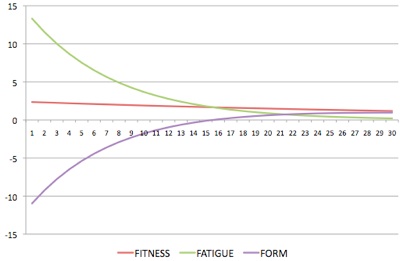
What is happening ? So we see that for a given training session the immediate effect is to increase your fatigue but also to increase your fitness by exposing your body to certain physiological demands during the training, it will adapt to those new demands placed on it. Initially the increase in fatigue far outweighs the increase in fitness but, since the fatigue effect decays quicker than the fitness effect, after a certain amount of time you will see performance improvements. The key to a training plan is to manage the training load so that your fitness improves over time whilst not letting fatigue increase so much that you are over trained. 

FORM.jpgThe graph shows the effect of a single training session over time. Fatigue starts much higher than fitness but after about 15 time periods the residual fitness is higher than the fatigue.  The graph uses the typical factors for increase in fitness / fatigue and speed of decay but every athlete is different and though this generalised approach deciding these factors for a specific athlete can optimise the increase in training loads and help develop the ideal taper.
How is this modelled ?

There are four parameters we are interested in:

  1. The fitness impact for a given training load
  2. The fatigue impact for a given training load
  3. The rate of decay of fitness
  4. The rate of decay of fatigue

The key is to establish what your parameters are. ie how much fatigue and fitness does a session create together with how quickly you lose this fatigue and fitness. I am using a tool called Raceday Apollo and testing it out with some athletes which helped model this whole process. The use of Power Meters, Heart Rate Monitors and recording swim sessions together with calculating critical speeds and powers for the individual allow a precise measurement of the stress of any given session. Regular testing allows the calibration of the model to define the above four parameters. From this it becomes easy to monitor fitness and fatigue gains together with planning towards a target performance.

I will continue this series of articles to go in to the details of assessing training stress, calculating critical speeds and ongoing testing of performance.

Posted in Advice | Leave a comment

Race Day Nutrition

Race nutrition is a sufficiently complex topic as to be considered the 4th discipline of long distance triathlon racing! There are plenty of guidelines given in sports training and nutrition resources, but as any athlete with even a moderate level of experience knows, what works for one person (or even most people) will not necessarily work for you. Standard advice or guidelines is given along the lines of 1 gram of carbs per kg body weight per hour. This is fine as a starting point – by looking at the nutrition contents on packaged foods we can easily work out  the correct amount of foods to meet this, but this requirement will vary much depending on the individual according to body composition, metabolism and fat oxidation efficiency, gastric tolerance, long term dietary habits as well as racing intensity and environmental conditions.  So, as that 4th discipline, we really should be making a little effort to understand our own nutritional needs and developing strategies to meet these requirements.

Part 1- race day

We need to know what energy forms, and how much, we can tolerate under race conditions, and since it’s very hard to replicate this in training this really comes down to racing experience. I’m preparing to race my 16th Ironman and by this stage I feel that I’ve refined my race day nutrition sufficiently to load-up the bento-box on race morning with confidence. That said, I’m still finding that my requirements do vary according to the race course and conditions, and so with each race there will be a few small tweaks or experiments.

I race at between 50 and 53kg, and my body composition is of relatively high muscle mass, and therefor fast metabolism. On the bike I output about 170W average over 5.5hrs which equates to about 600kJ/hr. I don’t know what my own personal energy conversion efficiency is (you can get this tested), but we’re all somewhere in the region of 25% – which is roughly how kJ equates to kCal. So that 600kJ of work can be taken as a 600 kCal burn. At my racing HR average of 155bpm, my metabolic testing indicates that I’m  utilizing 45% fat and 55% CHO, however the periods where I exceed this HR pushing me over Anaerobic Threshold and result in much less fat oxidization and carbs account for a greater proportion of my fuel supply than this average would suggest. I estimate 60% of my energy to be met by CHO.

So using my data as an example, at around 3W/kg that’s 11kCal/kg/hr. At 60% ChO (and there are 4kCal in each gram of carbohydrate) that’s just  2.7g of carbs per kg body weight per hour. For an 80kg athlete that’d be 216g per hour. Clearly it is unfeasible to expect to meet this during the race. Aside from the practicalities of carrying and consuming over a kilo of sugar, there’s a limit to how rapidly we can absorb foods which is further reduced by intense activity and elevated body temperature. I”ve read from various sources that 200-250kCal/hr is about the limit of what most people can process in a race. Assuming that this refers to a ‘typical male’ at 80kg I factor this down to 150/hour for myself and have worked on that. It’s a gel or half a bar every 40 min. Admittedly, I have not tried to consume more than this but have still managed to race well on less.

During the run I use a figure of 90kCal/mile or 13g CHO based on  60% at race intensity. That’s about 1.5kCal/kg/mile (0.25g CHO/kg/mile). For me that’d be 12-13 gels during the run. yuk. So, I assume that the150kCal/hr absorption works for me when running too (seems to be the case, though it may be that more sensitive people need to work with less) and take a gel every 40 min or so, equating to 4-5g CHO/mile (0.9g/kg/mile) plus some sports drink and coke.

As you see,  the best we can really hope for is to meet about 1/3 of our carbohydrate needs during the race and so our  race week dietary preparations are an important factor in the race nutrition equation. This is the topic of Part II. 

Back to race day – my strategy is:

breakfast about 2.5hr before race start – approx 400 kcal some low-fibre carb with fat +protein. in a hotel room this usually is some combination of peanut butter with either yoghurt & oats or a on bagel with cream cheese. and a coffee or two.

that’s it except for sipping water (unless coffee is available in the start area)

on the bike – aiming to consume at least 150 kCal/hr I put 8 gels in a bottle (800kCal) and top it up with water. I also pack a Powerbar cut into halves (100k Cal each half) and an extra gel. My estimated fuel use during a race is 550kCal/hr on the bike and i’ll do 350-400kCal in the swim. Personally, i like to eat some solid food during the day as i find gels down satisfy the ‘hungry’ sensation, but have learned that this must be early in the day if i want to run clear of the porta-loos. So i’ll swig some gel mix in the first 10 min of the bike and the next thing I eat is the bars, 20 and 60 minutes later. From there on it’s a gel swig every 20-30 min. I’ll usually grab a half banana or Powerbar around half way through the ride too. At aid stations I’m picking up sport drink if it’s hot and water. At Nice I had a can of Redbull in one of my bottles. That seemed to work well for me.

On the run –  gels, sport drink and coke. I take a caffeinated gel immediately out of transition and go for a gel every 45 min. I take water and sport drink alternately at aid stations, later stages of the run i’ll take coke. In Kona, for the first time I packed a can of Monster in run special needs. Again, that worked for me, but i did wonder how much is psychosomatic- it’s not as if i felt heaps better after consuming it, i just enjoyed having something to look forward to at mile 18.

This feeding strategy is common with the competitive ironman athletes that I know but it is something that I have arrived at through a process of refinement since my first ironman race which was fueled by a much more solid picnic of 9-bars, marzipan, fig rolls and peanuts with just one or two gels on the run. As my Ironman racing has progressed  to be more competitive, I’m racing at higher intensities and can less afford to be spending time for loo-breaks and gastric discomfort. I would still recommend a more solid race-day diet for the mid-pack or slower ironman athlete who will be racing at steadier intensity and expects to be out on the course for longer. This person requires greater sustenance and therefor palatability will  be of more importance than quick availability, fast energy release and ease of digestion. For this person I’d also recommend packing a good variety of foods – what tastes delicious to you in training, you may just not fancy eating on the day.

Whilst race experience is great – do more races, try more things discover what works and what doesn’t under different circumstances- with so many variables and the memory being unreliable (can you even remember what you ate 3 days ago?!) you need to do a little more than just that. You should keep records of what your nutrition, how you felt, and how the race went plus any other notes for future reference (such as “such and such product melted all over the place/stuck in my teeth/was too hard to unwrap” ) In the same way that you record your training, though a bit tedious,  it enables you over time to look back and find trends and patterns. It makes you preparations a lot simpler if you have a set of notes to hand which tell you exactly what you ate and drank in your last successful race as a starting point. 

Posted in Nutrition | Leave a comment

Camp Epilogue

dsc01297.jpg

It’s the day after the end of the camp with only Jo and I left in the hotel . After such an amazing week it feels very lonely here without everyone around. If a camp is judged by the party on the final night then this was clearly a good one. Drinks started by the pool as people cooled off after a big day in the saddle. Then there was the BBQ followed by heading out on the town. I found myself out with the hardcore who were clearly determined to out-last me. They did, when I pulled the pin at 3:50am. The following morning the banter was great and it was quite surprising how much Simon didn’t remember!

Over the years both of us have had numerous training ‘holidays’, either on our own or with one or two other people where we’ve just taken time off work and gone somewhere to run everyday or, since taking up triathlon, ride and run every day. Epic Camp just took that idea to another level, with it being a large group of athletes of a certain standard and a competition encouraging participants not only to push their training volume, but race hard at times when fatigued. Jo and I have both stretched ourselves on the 3 Epic Camps that we have attended, learned a lot from the other athletes and coaches we met whilst on camp and enjoyed them thoroughly. Since starting up EverydayTraining we’ve talked often about doing something similar – combining our own budget DIY  training holidays with the Epic Camp ethos. Getting a motivated group of mostly long distance athletes together and providing an environment where the focus is on training every day; filling most days with training; doing more than you perhaps think possible, but to also make it accessible – both in terms of cost and ability.

We were very lucky with this first camp in the group of people that came along. Everyone got on great and really threw themselves in to it. We did not set the camp up so someone could pick and chose what they did from a list of optional sessions – the idea was if you signed up you did everything. This was partially due to the limited resources we have, but we also felt that if people had thought they could just pick what to do, then there certainly would have been less commitment to each early morning swim or late afternoon run and it would have lessened the experience for everyone. As it was – everyone was in the ‘same boat’ and the group quickly bonded around this common goal of ‘completing’ a pretty daunting week schedule. Our impression was that most rather surprised themselves with what they can do when surrounded with like-minded individuals who are doing the same and offering support. Having catering provided buffet style on site, a cool pool to relax around with cold beers certainly helped. Another essential camp element was the massage service – this is an idea that we’ve taken from Epic camp, having really felt the benefits of the muscular care combined with half an hour of peaceful time in the hands of a sympathetic therapist. And it’s not just massage therapy – and aside form a great masseuse, Sarah turned out to be the hub of all camp gossip! Ali Mills came along in a support role for the physical therapy side of the camp, and really proved invaluable bringing with her physio expertise to the aid of a couple of people who’d shown up with injuries – and many more as they began to fall part under the grueling load .By day 5 I think that 80% of the camp had Kinesio tape holding bits of them together, and a few even let her poke acupuncture needles into them. Aside from these ‘fixes’ people really did value her advice and certainly one or two will see long term benefits as a  result of what they have learned from her.

The “Wild Card” process was put in place to try and encourage campers helping each other out to get through the camp. It certainly needs refining but I feel it caused enough excitement to warrant sticking with and trying to get it spot on. I found it rather amusing how people got excited to receive their playing card “wild card” even though there often wasn’t a realistic way to use it. It did prove it’s worth later in the week allowing many campers to really think through the last few days and do extra swim, bike and runs to allow an easier day before the final day and to avoid swimming on the last day.

Having spent so much time thinking about the schedule and sorting out the routes it was very pleasing to see that it all blended together better than we could have hoped. A couple of bike route changes were made for days 4 and 5 which I think will have to stay. Getting everyone climbing Femes was a highlight and managing to pace the groups so we did it together is something to attempt to repeat. Two races on the Tuesday is something I will certainly think over – that was one tough day after Monday with it’s very hard ride. Through the week, the rides formed a natural split into three paced groups – broadly: a small group of very fast riders who wanted to hammer around for 3-4hrs, the largest group of steady paced riders looking for a big mileage week with people of similar strength, or greater to help them along, and a slower group of riders who were being cautious with their pacing as daily long distance riding was new territory for them – often joined by members of the ‘steady group’ looking for a more social and lower intensity day. I spent a lot of time with the ‘fast group’ whilst between them Jo and Emma organised the other two. Emma’s riding strength and experience in group organisation, motivation and advice on cycling technique proved invaluable here, and enabled us to cater for the full range of cyclist that we had on the camp. We certainly would have been over-stretched without her help and seeing her strength on the bike ,especially up hills, was an inspiration for everyone too. We are extremely grateful for her giving up her time and joining us for the week.

We’d wanted all competitions for prizes to be attainable by all the athlete’s. With an inevitable range of ability, we needed to handicap the races. As it was the first ever camp, no one knew that the early races were used to handicap the later ones. This may not work so well in future camps but one way round it is to just do all races without revealing which is the handicapping race ,and which will be handicapped for the prizes. This rather takes the fun out of it and certainly won’t be as satisfying so maybe we’ll come up with an altogether new way of awarding prizes next time.

As for what the campers achieved I am really impressed. Everyone, bar two, did over 30 hours. The two were, me, who did a low level of running and Jon who did do everything, but very fast. We both still did over 28 hours training in the 6 days. The average training hours for the camp was 33 hours with Simon doing a staggering 37.4 hours. Roz managed the best part of 30 hours riding alone (Stats on the camp HERE.) Most people appeared strong on the last day finding that even a day of just a little less (not rest!) was enough to recharge them. The riding on the final day really made me proud of everyone and very happy. My group was thundering along and every summit we passed without seeing the others made me smile. It was also a great opportunity for Jo and I to spend some training time with some of the athletes that we coach. First refusal on places was offered to EDT athletes, as it will be on future camps, and it has been en excellent way of developing a better coaching relationship with those came along.

If we have our count correct, of the 13 campers and 5 staff we have 13 are racing Ironman Lanzarote and 1 Ironman Texas (on the same day) and I can’t wait to see how they all perform. With sufficient recovery from this camp they should have a great base of fitness to really go well. I’ll be on the sidelines cheering at Lanzarote which will be amazing given the number of these guys doing it. Fingers crossed for loads of great races so we can have a little reunion on Ali’i Drive.

Posted in Camps, Lanza 2011 | Tagged , | Leave a comment